Chaga SAP
by NFH · Capsule
Supplement facts from the label of Chaga SAP by NFH: Chaga Extract 350 mg.
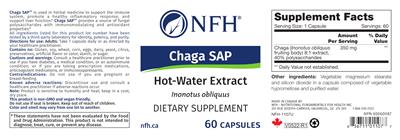
Supplement Facts
| Ingredient | Per serving | % DV | Upper limit (adults) |
|---|---|---|---|
| Chaga Extract (Inonotus obliquus, Polysaccharides) | 350 mg | — | — |
Upper limits: NIH ODS Fact Sheets for Health Professionals. Compared only where the unit converts and the limit applies to the form on the label.
On the label
For: Vegan · Vegetarian · Adult (18 - 50 Years) · Women (not pregnant or lactating) · Gluten Free · Dairy Free · Sugar Free
Claim types: All Other · Structure/Function
Formula re: Contains: Chaga SAP is used in herbal medicine to support the immune system, promote a healthy inflammatory response, and support liver function. Chaga SAP provides a source of fungal polysaccharides with immunomodulating and antioxidant properties.
Formulation re: Other: All ingredients listed for this product lot number have been tested by a third-party laboratory for identity, potency, and purity.
Suggested/Recommended/Usage/Directions: Directions for use: Adults: Take 1 capsule daily or as directed by your healthcare practitioner.
Formulation re: Does NOT Contain: Contains no: Gluten, soy, wheat, corn, eggs, dairy, yeast, citrus, preservatives, artificial flavor or color, starch, or sugar.
Precautions re: Pregnant or Nursing or Prescription Medications: Cautions and warnings: Consult a healthcare practitioner prior to use if you have diabetes, a medical condition, or an autoimmune condition; or if you are taking prescription medications, anticoagulant medications, or immunosuppressants. Contraindications: Do not use if you are pregnant or breast-feeding.
Precautions re: All Other: Known adverse reactions: Discontinue use and consult a healthcare practitioner if adverse reactions occur.
This page repeats what the label says and the official upper limits for healthy adults. It is not medical advice: ask a doctor, pharmacist or registered dietitian about your own intake, especially if you are pregnant, take medicines or have a health condition.
Label data: NIH Office of Dietary Supplements, Dietary Supplement Label Database (dsld.od.nih.gov), public domain. Upper limits: NIH ODS Fact Sheets for Health Professionals (values from the Institute of Medicine, Food and Nutrition Board).