Flaxseed Oil 1000 mg
by Meijer · Softgel Capsule
Supplement facts from the label of Flaxseed Oil 1000 mg by Meijer: Calories 10 Calorie(s), Total Fat 1.0 Gram(s), Flaxseed Oil 1,000 mg….
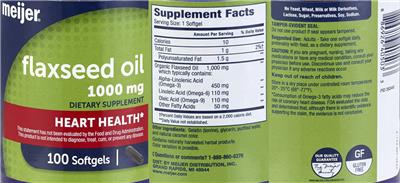
Supplement Facts
| Ingredient | Per serving | % DV | Upper limit (adults) |
|---|---|---|---|
| Calories | 10 Calorie(s) | — | — |
| Total Fat | 1.0 Gram(s) | 2% | — |
| └ Polyunsaturated Fat | 1.5 Gram(s) | — | — |
| Flaxseed Oil | 1,000 mg | — | — |
| └ Alpha-Linoleic Acid | 450 mg | — | — |
| └ Linoleic Acid | 110 mg | — | — |
| └ Oleic Acid | 110 mg | — | — |
| └ Other Fatty Acids | 50 mg | — | — |
Upper limits: NIH ODS Fact Sheets for Health Professionals. Compared only where the unit converts and the limit applies to the form on the label.
On the label
For: Adult (18 - 50 Years) · Gluten Free · Dairy Free · Sugar Free
Claim types: Nutrient · All Other · Qualified Health · Structure/Function
Formulation re: Other: Heart health Consumption of Omega-3 fatty acids may reduce the risk of coronary heart disease. FDA evaluated the data and determined that, although there is scientific evidence supporting the claim, the evidence is not conclusive.
FDA Disclaimer Statement: This statements has not been evaluated by the Food and Drug Administration. This product is not intended to diagnose, treat, cure, or prevent any disease.
Formulation re: Other: Contains naturally harvested herbal products. Color variation is possible.
Formulation re: Does NOT Contain: No yeast, wheat, milk or milk derivatives, lactose, sugar, preservatives, soy, sodium.
Precautions re: All Other: Tamper-evident seal: Do not use product if seal appears tampered.
Suggested/Recommended/Usage/Directions: Suggested Use: Adults - Take one softgel daily, preferably with food, as a dietary supplement.
This page repeats what the label says and the official upper limits for healthy adults. It is not medical advice: ask a doctor, pharmacist or registered dietitian about your own intake, especially if you are pregnant, take medicines or have a health condition.
Label data: NIH Office of Dietary Supplements, Dietary Supplement Label Database (dsld.od.nih.gov), public domain. Upper limits: NIH ODS Fact Sheets for Health Professionals (values from the Institute of Medicine, Food and Nutrition Board).