Kre-Alkalyn EFX
by EFX Sports · Capsule
Supplement facts from the label of Kre-Alkalyn EFX by EFX Sports: Kre-Alkalyn 1,500 mg.
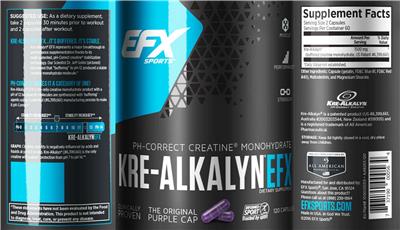
Supplement Facts
| Ingredient | Per serving | % DV | Upper limit (adults) |
|---|---|---|---|
| Kre-Alkalyn | 1,500 mg | — | — |
Upper limits: NIH ODS Fact Sheets for Health Professionals. Compared only where the unit converts and the limit applies to the form on the label.
On the label
For: Adult (18 - 50 Years)
Claim types: All Other · Structure/Function
Suggested/Recommended/Usage/Directions: Suggested Use: As a dietary supplement, take 2 capsules 30 minutes prior to workout and 2 capsules after workout.
Formulation re: Other: Kre-Alkalyn EFX... It’s Buffered. It’s stable. Kre-Alkalyn EFX represents a major breakthrough in performance supplementation thanks to its multi-patented, pH-Correct creatine stabilization technology. Our Scientist Dr. Jeff Golini (pictured) discovered that “buffering” to pH-12 produced a stable creatine monohydrate molecule.
Formulation re: Other: PH-Correct Makes it a Category of One! Kre-Alkalyn EFX is the only creatine monohydrate product with a pH of 12 because its molecules are synthesized with ‘buffering’ agents using a patented (#6,399,661) manufacturing process to make it pH-Correct.
Formulation re: Other: Graph: Creatine stability is negatively influenced by acids and liquids at pH 6.9 or less. Kre-Alkalyn (#6,399,661) is the only creatine with patent-protection from pH 7 to pH 14.
FDA Disclaimer Statement: These statements have not been evaluated by the Food and Drug Administration. This product is not intended to diagnose, treat, cure, or prevent any disease.
Formulation re: Other: Muscle Performance Strength
This page repeats what the label says and the official upper limits for healthy adults. It is not medical advice: ask a doctor, pharmacist or registered dietitian about your own intake, especially if you are pregnant, take medicines or have a health condition.
Label data: NIH Office of Dietary Supplements, Dietary Supplement Label Database (dsld.od.nih.gov), public domain. Upper limits: NIH ODS Fact Sheets for Health Professionals (values from the Institute of Medicine, Food and Nutrition Board).