Red Yeast Rice 600 mg with CoQ10
by Best Naturals · Capsule
Supplement facts from the label of Red Yeast Rice 600 mg with CoQ10 by Best Naturals: Red Yeast Rice 1,200 mg, Coenzyme Q10 60 mg.
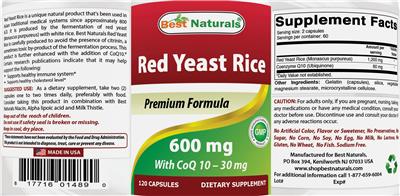
Supplement Facts
| Ingredient | Per serving | % DV | Upper limit (adults) |
|---|---|---|---|
| Red Yeast Rice | 1,200 mg | — | — |
| Coenzyme Q10 (Ubiquinone) | 60 mg | — | — |
Upper limits: NIH ODS Fact Sheets for Health Professionals. Compared only where the unit converts and the limit applies to the form on the label.
On the label
For: Adult (18 - 50 Years) · Gluten Free · Dairy Free · Sugar Free
Claim types: All Other · Structure/Function
Formula re: Contains: Red Yeast Rice is a unique natural product that's been used in Asian traditional medical systems since approximately 800 A.D. It is produced by the fermentation of red yeast (Monascus purpureus) with white rice. Best Naturals Red Yeast Rice is carefully produced to avoid the presence of citrinin, a sometimes toxic by-product of the fermentation process. This product is further enhanced with the ad
Suggested/Recommended/Usage/Directions: Suggested Use: As a dietary supplement, take two (2) capsules one to two times daily, preferably with food. Consider taking this product in combination with Best Naturals Niacin, Alpha lipoic acid and Milk Thistle.
Precautions re: Children: Keep out of the reach of children.
Precautions re: All Other: Do not use if safety seal is broken or missing.
Storage: Keep in cool, dry place.
FDA Disclaimer Statement: These statements have not been evaluated by the Food and Drug Administration. This product is not intended to diagnose, treat, cure or prevent any disease.
This page repeats what the label says and the official upper limits for healthy adults. It is not medical advice: ask a doctor, pharmacist or registered dietitian about your own intake, especially if you are pregnant, take medicines or have a health condition.
Label data: NIH Office of Dietary Supplements, Dietary Supplement Label Database (dsld.od.nih.gov), public domain. Upper limits: NIH ODS Fact Sheets for Health Professionals (values from the Institute of Medicine, Food and Nutrition Board).