Norwegian Cod Liver Oil
by Twinlab · Liquid
Supplement facts from the label of Norwegian Cod Liver Oil by Twinlab: Calories 45 Calorie(s), Total Fat 5.0 Gram(s), Cholesterol 25 mg, Vitamin A 1,500 mcg RAE….
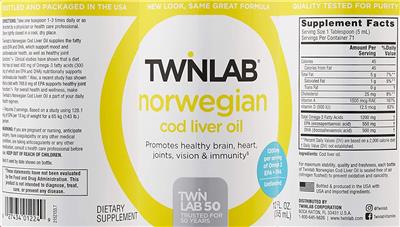
Supplement Facts
| Ingredient | Per serving | % DV | Upper limit (adults) |
|---|---|---|---|
| Calories | 45 Calorie(s) | — | — |
| └ Calories from Fat | 45 Calorie(s) | — | — |
| Total Fat | 5.0 Gram(s) | 7% | — |
| └ Saturated Fat | 1.0 Gram(s) | 5% | — |
| └ Trans Fat | 0.00 Gram(s) | — | — |
| Cholesterol | 25 mg | 8% | — |
| Vitamin A | 1,500 mcg RAE | 167% | — |
| Vitamin D | 13 mcg | 63% | 100 mcg · 38% at label max |
| Total Omega-3 Fatty Acids | 1,200 mg | — | — |
| └ EPA | 550 mg | — | — |
| └ DHA | 500 mg | — | — |
Upper limits: NIH ODS Fact Sheets for Health Professionals. Compared only where the unit converts and the limit applies to the form on the label.
On the label
For: Adult (18 - 50 Years)
Claim types: Nutrient · All Other · Structure/Function
Formulation re: Other: Bottle and Packaged in the USA New look, same great formula Quality Tested for Purity
Suggested/Recommended/Usage/Directions: Directions: Take one teaspoon 1-3 times daily or as directed by a physician or health care professional.
Storage: Store tightly closed in a cool, dry place.
Formula re: Contains: Twinlab's Norwegian Cod Liver Oil supplies the fatty acids EPA and DHA, which support mood and cardiovascular healthy, as well as healthy joint function. Clinical studies have shown that a diet that has at least 400 mg of Omega-3 fatty acids (300 mg of which are EPA and DHA) nutritionally supports cardiovascular health. Also, a recent study has shown that a diet with 768.6 mg of EPA supports healt
Suggested/Recommended/Usage/Directions: Requires 2 servings. Based on a study using 128.1 mg of EPA per 10 kg of weight for a 65 kg (143 lb.) person.
Precautions re: Pregnant or Nursing or Prescription Medications: Warning: If you are pregnant or nursing, anticipate surgery, have coagulopathy or any other medical condition, are taking anticoagulants or any other medication, consult a health care professional before use.
This page repeats what the label says and the official upper limits for healthy adults. It is not medical advice: ask a doctor, pharmacist or registered dietitian about your own intake, especially if you are pregnant, take medicines or have a health condition.
Label data: NIH Office of Dietary Supplements, Dietary Supplement Label Database (dsld.od.nih.gov), public domain. Upper limits: NIH ODS Fact Sheets for Health Professionals (values from the Institute of Medicine, Food and Nutrition Board).