Spirulina Tablet
by Herbal Hills · Tablet or Pill
Supplement facts from the label of Spirulina Tablet by Herbal Hills: Calories 2.9 Kcal, Total Fat 0.05 Gram(s), Sodium 11 mg, Potasium 13 mg….
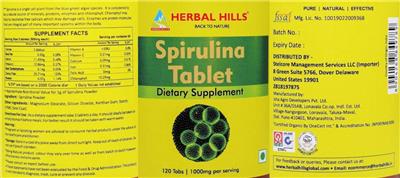
Supplement Facts
| Ingredient | Per serving | % DV | Upper limit (adults) |
|---|---|---|---|
| Calories | 2.9 Kcal | — | — |
| Total Fat | 0.05 Gram(s) | 0% | — |
| Sodium | 11 mg | 0% | — |
| Potasium | 13 mg | 0% | — |
| Total Carbohydrate | 0.14 Gram(s) | 0% | — |
| Dietary Fiber | 26 mg | 103% | — |
| Protein | 0.57 Gram(s) | 1% | — |
| Vitamin A | 50 IU | 1% | — |
| Vitamin C | 0.01 mg | 0% | 2,000 mg · 0% at label max |
| Calcium | 6.1 mg | 1% | 2,500 mg · 0% at label max |
| Iron | 0.51 mg | 3% | 45 mg · 1% at label max |
| Folic Acid | 0.00 mcg | 0% | — |
| Chlorophyll | 10 mg | — | — |
| Spirulina powder | 0.00 NP | — | — |
Upper limits: NIH ODS Fact Sheets for Health Professionals. Compared only where the unit converts and the limit applies to the form on the label.
On the label
For: Adult (18 - 50 Years) · Halal
Claim types: All Other · Structure/Function
Formula re: Contains: Spirulina is a single cell plant from the blue green algae species. It is considered to be a natural source of minerals, proteins, enzymes and chlorophyll. Chlorophyll may help to neutralize free radicals which may damage cells. Enzymes are protein molecules that are integral part of many important systems within the body.
Formulation re: Other: Approximate Nutritional Value for 1 g of Spirulina Powder
Suggested/Recommended/Usage/Directions: Directions for use: As a dietary supplement take 2 tablets a day. It should ideally be taken on empty stomach before meals. For better result it should be taken with warm water.
Precautions re: Pregnant or Nursing or Prescription Medications: Warning: Pregnant or lactating women are advised to consume herbal products under the advice of the healthcare practitioner.
Storage: Storage: Store in a cool dry place away from direct sunlight.
Precautions re: Children: Keep out of reach of children.
This page repeats what the label says and the official upper limits for healthy adults. It is not medical advice: ask a doctor, pharmacist or registered dietitian about your own intake, especially if you are pregnant, take medicines or have a health condition.
Label data: NIH Office of Dietary Supplements, Dietary Supplement Label Database (dsld.od.nih.gov), public domain. Upper limits: NIH ODS Fact Sheets for Health Professionals (values from the Institute of Medicine, Food and Nutrition Board).