MCT Oil
by Metagenics · Liquid
Supplement facts from the label of MCT Oil by Metagenics: Calories 90 Calorie(s), Total Fat 10 Gram(s), Medium-Chain Triglycerides 10 Gram(s).
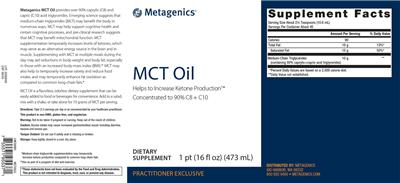
Supplement Facts
| Ingredient | Per serving | % DV | Upper limit (adults) |
|---|---|---|---|
| Calories | 90 Calorie(s) | — | — |
| Total Fat | 10 Gram(s) | 13% | — |
| └ Saturated Fat | 10 Gram(s) | 50% | — |
| Medium-Chain Triglycerides (Caprylic + Capric Acid Triglycerides) | 10 Gram(s) | — | — |
Upper limits: NIH ODS Fact Sheets for Health Professionals. Compared only where the unit converts and the limit applies to the form on the label.
On the label
For: Vegetarian · Adult (18 - 50 Years) · Women (not pregnant or lactating) · Gluten Free
Claim types: Nutrient · All Other · Structure/Function
Formula re: Contains: Metagenics MCT Oil provides over 90% caprylic (C8) and capric (C10) acid triglycerides. Emerging science suggests that medium-chain triglycerides (MCT) may benefit the body in numerous ways. MCT may help support cognitive health and certain cognitive processes, and pre-clinical research suggests that MCT may benefit mitochondrial function. MCT supplementation temporarily increases levels of ketone
Suggested/Recommended/Usage/Directions: MCT Oil is a flavorless, odorless dietary supplement that can be easily added to food or beverages for convenience. Add to a salad, mix with a shake, or take alone for 10 grams of MCT per serving. Directions: Take 2-3 servings per day or as recommended by your healthcare practitioner.
Formulation re: Does NOT Contain: This product is non-GMO, gluten-free, and vegetarian.
Formulation re: Vegetarian/Vegan: This product is non-GMO, gluten-free, and vegetarian.
Precautions re: Pregnant or Nursing or Prescription Medications: Warning: Not to be taken if pregnant or nursing.
Precautions re: Children: Keep out of the reach of children.
This page repeats what the label says and the official upper limits for healthy adults. It is not medical advice: ask a doctor, pharmacist or registered dietitian about your own intake, especially if you are pregnant, take medicines or have a health condition.
Label data: NIH Office of Dietary Supplements, Dietary Supplement Label Database (dsld.od.nih.gov), public domain. Upper limits: NIH ODS Fact Sheets for Health Professionals (values from the Institute of Medicine, Food and Nutrition Board).