MCT Oil Rx
by Taylor MD Formulations · Powder
Supplement facts from the label of MCT Oil Rx by Taylor MD Formulations: Calories 100 Calorie(s), Calories from Fat 100 Calorie(s), Total Fat 14 Gram(s), Saturated Fat 14 Gram(s)….
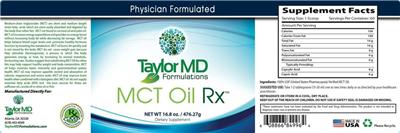
Supplement Facts
| Ingredient | Per serving | % DV | Upper limit (adults) |
|---|---|---|---|
| Calories | 100 Calorie(s) | — | — |
| Calories from Fat | 100 Calorie(s) | — | — |
| Total Fat | 14 Gram(s) | — | — |
| Saturated Fat | 14 Gram(s) | — | — |
| Trans Fat | 0.00 Gram(s) | — | — |
| Polyunsaturated Fat | 0.00 Gram(s) | — | — |
| Monounsaturated Fat | 0.00 Gram(s) | — | — |
| └ Caprylic Acid | 8.0 Gram(s) | — | — |
| └ Capric Acid | 6.0 Gram(s) | — | — |
Upper limits: NIH ODS Fact Sheets for Health Professionals. Compared only where the unit converts and the limit applies to the form on the label.
On the label
For: Adult (18 - 50 Years)
Claim types: Nutrient · All Other · Structure/Function
Formula re: Contains: Medium-chain triglycerides (MCT) are short and medium length chain fatty acids which are more easily absorbed and digested by the body than other fats. MCT are found in coconut oil and palm oil. MCT oil increases energy expenditure and provides an energy boost without increasing body fat while decreasing fat storage. MCT oil helps balance blood sugar levels and promotes healthy hormone function by
Formulation re: Does NOT Contain: MCT oil do not supply essential fatty acids (EFA) and the best sources for these are safflower oil, canola oil or olive oil or fish.
Seals/Symbols: Pharmaceutical Licensed Manufacturing Rx GMP
Formulation re: Other: Physician formulated
Suggested/Recommended/Usage/Directions: Suggested use: Take 1-2 tablespoons (15-30 ml) one to two times daily or as directed by your healthcare practitioner.
Storage: Refrigerate or store in a cool, dry place.
This page repeats what the label says and the official upper limits for healthy adults. It is not medical advice: ask a doctor, pharmacist or registered dietitian about your own intake, especially if you are pregnant, take medicines or have a health condition.
Label data: NIH Office of Dietary Supplements, Dietary Supplement Label Database (dsld.od.nih.gov), public domain. Upper limits: NIH ODS Fact Sheets for Health Professionals (values from the Institute of Medicine, Food and Nutrition Board).