Flaxseed Oil 1,000 mg
by Woodstock Vitamins · Softgel Capsule
Supplement facts from the label of Flaxseed Oil 1,000 mg by Woodstock Vitamins: Total Calories 10 Calorie(s), Total Fat 1.0 Gram(s), Flaxseed Oil 1,000 mg.
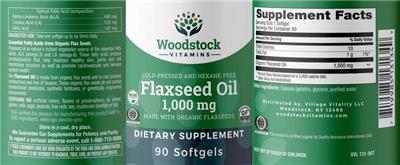
Supplement Facts
| Ingredient | Per serving | % DV | Upper limit (adults) |
|---|---|---|---|
| Total Calories | 10 Calorie(s) | — | — |
| Total Fat | 1.0 Gram(s) | 1% | — |
| Flaxseed Oil | 1,000 mg | — | — |
Upper limits: NIH ODS Fact Sheets for Health Professionals. Compared only where the unit converts and the limit applies to the form on the label.
On the label
For: Adult (18 - 50 Years) · Organic · Gluten Free · Dairy Free
Claim types: Nutrient · All Other · Structure/Function
Formula re: Contains: Typical Fatty Acid Composition: Alpha-Linolenic Acid (ALA) 440 mg Linoleic Acid (LA) 120 mg Oleic Acid 142 mg
Suggested/Recommended/Usage/Directions: Suggested Use: Take one softgel up to six times daily.
Formula re: Contains: Essential fatty acids from organic flax seeds Flaxseed oil is nature's richest vegetarian source of the essential fatty acids, ALA (omega-3) and LA (omega-6).
Formulation re: Other: These fatty acids produce prostaglandins that help maintain healthy skin, joints and cell membrane structure as well as promote cardiovascular and nervous system health.
Formulation re: Does NOT Contain: Our Flaxseed Oil is made from organic flax seeds and is cold pressed, unbleached and free of hexane. These organic flax seeds do not contain conventional pesticides, synthetic fertilizers, or genetic engineered components. Contains no artificial colors, flavors or preservatives; no wheat, gluten, milk, eggs, peanuts, tree nuts, soy, crustacean shellfish or fish. SGS verified the process for manuf
Storage: Store in a cool, dry place.
This page repeats what the label says and the official upper limits for healthy adults. It is not medical advice: ask a doctor, pharmacist or registered dietitian about your own intake, especially if you are pregnant, take medicines or have a health condition.
Label data: NIH Office of Dietary Supplements, Dietary Supplement Label Database (dsld.od.nih.gov), public domain. Upper limits: NIH ODS Fact Sheets for Health Professionals (values from the Institute of Medicine, Food and Nutrition Board).