VitaPQQ-SR
by Quality of Life · Capsule
Supplement facts from the label of VitaPQQ-SR by Quality of Life: Pyrroloquinoline Quinone Disodium Salt 10 mg.
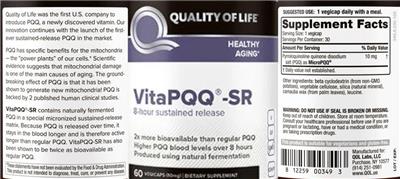
Supplement Facts
| Ingredient | Per serving | % DV | Upper limit (adults) |
|---|---|---|---|
| Pyrroloquinoline Quinone Disodium Salt (MicroPQQ) | 10 mg | — | — |
Upper limits: NIH ODS Fact Sheets for Health Professionals. Compared only where the unit converts and the limit applies to the form on the label.
On the label
For: Vegetarian · Adult (18 - 50 Years) · Gluten Free
Claim types: All Other · Structure/Function
Formulation re: Other: Quality of Life was the first U.S. company to introduce PQQ, a newly discovered vitamin. Our innovation continues with the launce of the first-ever sustained-release PQQ in the market. PQQ has specific benefits for the mitochondria - the "power plants" of our cells. Scientific evidence suggests that mitochondrial damage is one of the main causes of aging. The ground-breaking effect of PQQ is that
Formula re: Contains: VitaPQQ-SR contains naturally fermented PQQ in a specific micronized sustained-release matrix. Because PQQ is released over time, it stays in the blood longer and is therefore active longer than regular PQQ. VitaPQQ-SR has also been shown to be twice as bioavailable as regular PQQ.
FDA Disclaimer Statement: These statements have not been evaluated by the Food & Drug Administration. This product is not intended to diagnose, treat, cure or prevent any disease.
Formulation re: Other: Healthy Aging 8-hour sustained release
Formulation re: Other: 2x more bioavailable than regular PQQ Higher PQQ blood levels over 8 hours Produced using natural fermentation
Suggested/Recommended/Usage/Directions: Suggested Use: 1 vegicap daily with a meal.
This page repeats what the label says and the official upper limits for healthy adults. It is not medical advice: ask a doctor, pharmacist or registered dietitian about your own intake, especially if you are pregnant, take medicines or have a health condition.
Label data: NIH Office of Dietary Supplements, Dietary Supplement Label Database (dsld.od.nih.gov), public domain. Upper limits: NIH ODS Fact Sheets for Health Professionals (values from the Institute of Medicine, Food and Nutrition Board).