Vitamin D3 Complete Softgels
by Allergy Research Group · Softgel Capsule
Supplement facts from the label of Vitamin D3 Complete Softgels by Allergy Research Group: Vitamin A 900 mcg RAE, Vitamin D3 50 mcg, Vitamin K2 100 mcg, Tocotrienols 5.0 mg.
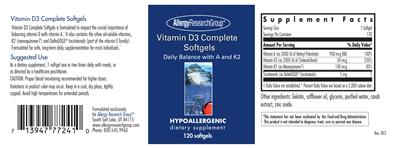
Supplement Facts
| Ingredient | Per serving | % DV | Upper limit (adults) |
|---|---|---|---|
| Vitamin A (Retinyl Palmitate) | 900 mcg RAE | 100% | — |
| Vitamin D3 (Cholecalciferol) | 50 mcg | 250% | 100 mcg · 100% at label max |
| Vitamin K2 (Menaquinone-7) | 100 mcg | 83% | — |
| Tocotrienols (DeltaGOLD Tocotrienols) | 5.0 mg | — | — |
Upper limits: NIH ODS Fact Sheets for Health Professionals. Compared only where the unit converts and the limit applies to the form on the label.
On the label
For: Adult (18 - 50 Years)
Claim types: Nutrient · All Other · Structure/Function
Formula re: Contains: Vitamin D3 Complete Softgels is formulated to respect the crucial importance of balancing vitamin D with vitamin A. It also contains the other oil-soluble vitamins, K2 (menaquinone-7) and DeltaGOLD tocotrienols (part of the vitamin E family).
Formulation re: Other: Formulated for safe, long-term daily supplementation for most individuals.
Suggested/Recommended/Usage/Directions: Suggested Use As a dietary supplement, 1 softgel one or two times daily with meals, or as directed by a healthcare practitioner.
Precautions re: All Other: Caution: Proper blood monitoring recommended for higher doses.
Formulation re: Other: Variations in product color may occur.
Storage: Keep in cool, dry place, tightly capped. Avoid high temperatures for extended periods.
This page repeats what the label says and the official upper limits for healthy adults. It is not medical advice: ask a doctor, pharmacist or registered dietitian about your own intake, especially if you are pregnant, take medicines or have a health condition.
Label data: NIH Office of Dietary Supplements, Dietary Supplement Label Database (dsld.od.nih.gov), public domain. Upper limits: NIH ODS Fact Sheets for Health Professionals (values from the Institute of Medicine, Food and Nutrition Board).